Singita: Pioneering Luxury Safaris
The Legend Begins
The story of Singita begins not in 1993, but nearly seven decades earlier. In 1925, Luke Bailes’ grandfather purchased a tract of land in what would eventually become South Africa’s legendary Sabi Sand Game Reserve. For generations, this remote corner of the Lowveld served as a family retreat, a place where young Luke would spend childhood holidays falling in love with the African bush. The land was originally used for hunting, as was common in that era, but the seeds of a different vision were quietly taking root.
By the early 1990s, Luke Bailes recognized a profound shift in how people related to Africa’s wilderness. The era of trophy hunting was giving way to something more meaningful: the desire to witness wildlife in its natural state while enjoying world-class hospitality. In 1993, Bailes bought and consolidated the family land from his grandfather and, together with his childhood friend Mark Witney, opened Singita Ebony Lodge on the banks of the Sand River. The name “Singita,” meaning “place of miracles” in the local Shangaan language, would prove prophetic.
The Founder’s Vision
Luke Bailes was not a hotelier by training, nor was he a conservationist by profession. He was simply someone who understood, from years of observing the bush, that the fate of Africa’s wilderness depended on giving it economic value. His revolutionary insight was marrying high-value, low-impact tourism with genuine conservation. Rather than maximizing guest numbers, Singita would charge premium rates for an exclusive experience, ensuring minimal environmental footprint while generating substantial funds for habitat protection.
From the beginning, Bailes established a philosophy that still guides every decision: “touch the earth lightly.” The earliest aerial photographs of the property, taken in 1935, became the template for restoration efforts. Where others saw a business opportunity, Bailes saw a responsibility. The first breakthrough came when Ebony Lodge challenged existing ideas of excellence within the safari industry, proving that luxury and conservation were not merely compatible but mutually reinforcing. Mark Witney, who started as a pilot, guide, and lodge host, would become instrumental in building Singita’s conservation operations over the following 26 years.
Rise to Excellence
The success of Ebony Lodge quickly validated Bailes’ vision. In 1996, Singita Boulders Lodge opened, introducing a more contemporary architectural approach while maintaining the same commitment to excellence. Where Ebony offered colonial charm, Boulders brought modern design organically inspired by the surrounding landscape, with structures built around massive granite formations along the Sand River.
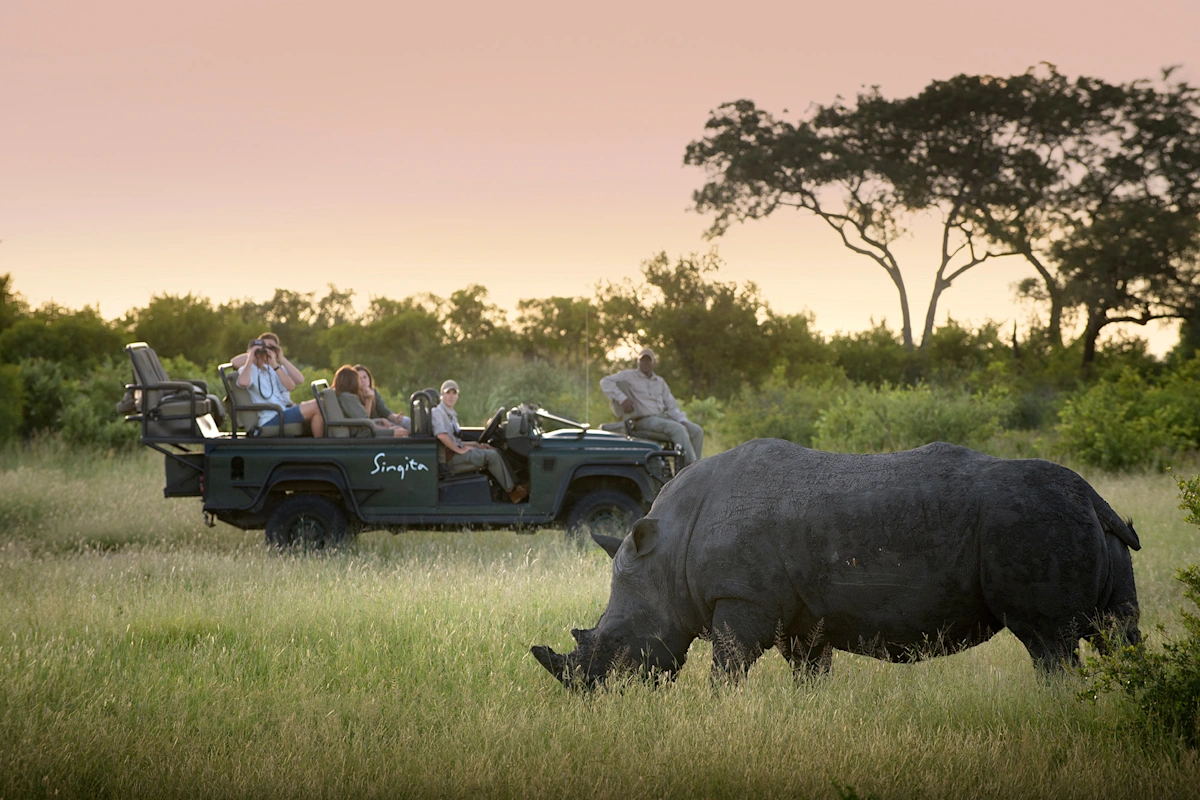
The pivotal expansion came in 2003 when Singita took over management of more than 350,000 acres in Tanzania’s Serengeti ecosystem. The area had been devastated by uncontrolled poaching, rampant wildfires, and invasive vegetation. Working with the non-profit Grumeti Fund, Singita transformed this barren landscape into one of Africa’s most remarkable conservation success stories. Wildlife populations recovered dramatically, and in 2019, the Fund carried out the largest single relocation of nine critically endangered Eastern Black Rhinos.
Further milestones followed: the 115,000-acre Malilangwe Wildlife Reserve in Zimbabwe, where rhino populations were successfully reestablished; Singita Lebombo and Sweni lodges in a private Kruger concession; and in 2019, Singita Kwitonda Lodge in Rwanda’s Volcanoes National Park, built at the invitation of the Rwandan President to support mountain gorilla conservation. Each expansion was guided by the same principle: conservation first, luxury as the enabler.
Iconic Creations
Singita’s portfolio represents a masterclass in location-specific design. In the Sabi Sand, Ebony Lodge retains its warm, classic safari aesthetic with 12 suites overlooking the Sand River, famous for extraordinary leopard sightings. Boulders Lodge, also with 12 suites, offers a more contemporary experience with floor-to-ceiling glass walls and private plunge pools built into the rocky landscape.
In Tanzania, Sasakwa Lodge sits atop a hill commanding sweeping views of the Serengeti plains, while Faru Faru Lodge brings an eclectic, artistic sensibility to the bush. Singita Lebombo, cantilevered over rocks above the Sweni River in Kruger, represents cutting-edge sustainable architecture. In Rwanda, Kwitonda Lodge set new benchmarks for eco-conscious construction, with local volcanic stone, native vegetation, and hybrid solar systems eliminating the need for air conditioning.
What unites these diverse properties is an unwavering commitment to authentic experience. Singita’s wine collection has become legendary among connoisseurs, while its Community Culinary School trains local talent, with 70% of graduates finding employment. Every element, from the African art collections to the expert guides, serves the larger purpose of connecting guests emotionally to the wilderness.
The Numbers: Empire Today
Today, Singita operates 19 lodges, camps, and exclusive-use villas across six locations in four countries: South Africa (Sabi Sand and Kruger National Park), Zimbabwe (Malilangwe), Tanzania (Serengeti), and Rwanda (Volcanoes National Park). The company remains privately owned, with Luke Bailes and his sons at the helm, ensuring the founding vision remains undiluted.
Singita’s conservation footprint now extends to close to one million acres of protected African wilderness. The company employs hundreds of people across the continent, with significant emphasis on hiring from local communities. In Tanzania alone, the Grumeti Fund employs 100 game scouts, the majority of whom are reformed poachers who now protect the wildlife they once hunted.
In November 2024, Singita announced its expansion into Botswana with Singita Elela, set to open in late 2026 in the Okavango Delta. The new property will offer exclusive access to a 170,000-hectare private concession, formerly known as the Abu Concession. In 2023, Singita’s Kruger National Park operation won the prestigious Flor de Caña Eco Hotel Award for its sustainability principles. The brand has also been consistently recognized by Travel + Leisure, Condé Nast Traveler, and was included in The World’s 50 Best Hotels list.
The Legacy Continues
Under Luke Bailes’ continued leadership, Singita pursues what it calls its “100-year purpose”: to preserve and protect large areas of African wilderness for future generations. In 2024, the company transitioned from Bioregional’s One Planet Living framework to partnering with The Long Run, joining a global community of eco-tourism leaders committed to the 4C sustainability principles of Conservation, Community, Culture, and Commerce.
Recent innovations include ambitious targets for carbon neutrality, elimination of single-use plastics, and expanded community partnership programs focusing on early childhood education and small enterprise development. The upcoming Singita Elela in Botswana will showcase the brand’s most advanced sustainable design yet, elevated off the ground to minimize environmental impact and built using locally sourced materials.
Singita is also exploring opportunities in Kenya and coastal regions, though any expansion must meet the brand’s exacting conservation criteria. As Bailes has often emphasized, growth for its own sake holds no appeal; every new property must advance the mission of protecting Africa’s wilderness.
Why It Matters
In a world where Africa’s wildlife populations have declined by 60% in four decades and the continent’s human population is projected to reach 4.4 billion by century’s end, Singita represents more than luxury hospitality. It is a working model for how tourism can become the economic engine that saves wilderness. From a single lodge on family land to a million-acre conservation footprint spanning four nations, Singita has proven that the world’s wealthiest travelers will pay premium prices to experience pristine nature, and that those revenues can fund the protection that makes such experiences possible. For luxury connoisseurs, a stay at Singita is not simply a safari; it is participation in one of conservation’s most inspiring success stories.