Cristal: The Champagne of Tsars and Stars
The Legend Begins
In the heart of Reims, France, a story of exceptional luxury began not with Louis Roederer himself, but with an earlier foundation. The house was initially founded as Dubois Père & Fils in 1776, and it was only in 1833 that Louis Roederer inherited the company from his uncle, renamed it eponymously, and set about transforming it into one of Champagne’s most distinguished houses.
Roederer was a visionary businessman who understood that creating champagne of exceptional quality required controlling the entire production process. Unlike other houses of his era that relied on purchasing grapes through contracts, he chose to nurture his own terroirs. In the mid-nineteenth century, Louis Roederer acquired some of Champagne’s grand cru vineyards, an approach that contrasted sharply with contemporary practices. He began building what would become an exceptional estate, methodically acquiring the finest parcels in the Montagne de Reims, the Côte des Blancs, and the Vallée de la Marne.
His guiding principle was revolutionary for the time: all great wine depends on the quality of the soil, a passion for tradition, and an astute vision of the future. This philosophy remains at the heart of Louis Roederer to this day, making it one of the few major Champagne houses to own approximately 240 hectares of vineyards across 410 parcels, supplying two-thirds of its production needs.
The Founder’s Vision
When Louis Roederer inherited the champagne house in 1833, he embarked on a journey that would forever change the landscape of luxury champagne. His personal drive and innovative mindset propelled him to take bold steps that set the house apart from its competitors. By the period between 1832 and 1870, under his direction, the house gained top ranking worldwide with sales of 2.5 million bottles, including 390,000 in the United States and an extraordinary 660,000 in Russia.
Russia became Louis Roederer’s most important market. Champagne had increased dramatically in popularity with the Russian nobility from 1855 onwards, and Roederer shipped a third of his entire production to the imperial court. The house’s reputation grew so significantly that Tsar Nicholas II nominated Louis Roederer as the official wine supplier to the Imperial Court of Russia, cementing its status among the world’s elite champagne producers.
His successor, Louis Roederer II, was equally enlightened and adopted his father’s conscientious approach to champagne production and estate management. It was he who would create the house’s most legendary cuvée, forever linking the Roederer name with imperial luxury.
Rise to Excellence: The Birth of Cristal
The story of Cristal is deeply intertwined with a pivotal period in European history. In 1867, Tsar Alexander II visited Paris for the Exposition Universelle. The political situation in Russia was unstable, and the Tsar, having survived multiple assassination attempts, was justifiably paranoid about his safety. When he hosted a lavish dinner for Prussian King Wilhelm I and Chancellor Otto von Bismarck, later termed the Three Emperors’ Dinner, he made an unusual request.
The Tsar demanded that Louis Roederer create a champagne unlike any other, served in bottles that would allow him to see the wine was pure and free from poison. He also insisted that the bottle have a flat bottom, rather than the traditional punt, to prevent explosives from being concealed beneath. Louis Roederer commissioned a Flemish glassmaker to create a clear lead-crystal bottle meeting these precise specifications.
In 1876, Cristal was officially born, named after the precious material of its distinctive bottle. This exceptional champagne was reserved exclusively for the Russian imperial court. The Tsar requested that the house reserve its finest cuvée for him every year. The flat-bottomed, transparent crystal bottle became the ultimate symbol of luxury and rarity, and Cristal is widely regarded as the world’s first prestige cuvée.
Tsar Alexander II’s paranoia proved tragically justified. He was ultimately assassinated in 1881 by a hand-thrown explosive from a member of a revolutionary organisation. Despite his precautions, the specially designed bottle could not protect him from his fate, but it created an enduring legend in the world of champagne.
Surviving Revolution and Rebuilding
The 20th century brought devastating challenges to Champagne Louis Roederer. The Russian Revolution of 1917 ended the reign of the Tsars and with it, Cristal lost approximately 75-80% of its market virtually overnight. American Prohibition compounded the crisis, eliminating the house’s second largest market. The Great Depression and two World Wars, which devastated much of the Champagne region, nearly destroyed what Louis Roederer had built.
In 1932, when her husband Léon Olry-Roederer died, Camille Olry-Roederer inherited a business on the verge of bankruptcy. Sales had plummeted from 2.3 million bottles per year to just 264,000. She was an outsider who knew nothing about making champagne and was not well received in the region. Yet Camille possessed extraordinary determination and business acumen.
Camille surrounded herself with an exceptionally competent team, which she managed with what her great-grandson describes as “an iron fist in a velvet glove.” Understanding the importance of vineyard ownership, she bought as many parcels as she could, including prestigious holdings in the Côte des Blancs. She also embraced the social and glamorous aspects of champagne, hosting legendary receptions in the family’s Hôtel Particulier in Reims and using her prize-winning racehorses to access American high society. Her horse Jamin won the America Cup three times, and Camille was greeted as the “queen of champagne” during her promotional tours.
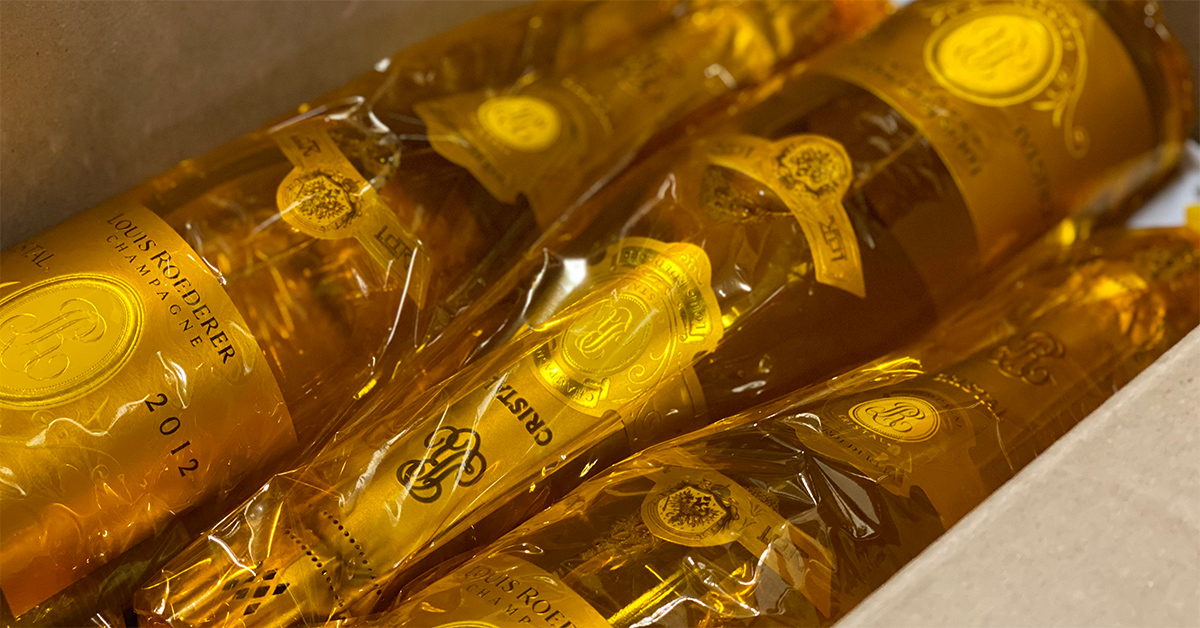
In 1945, right after the end of World War II, the house decided to revive Cristal and offer it to commercial consumers for the first time in history, using the same flat-bottomed crystal bottle design dedicated to Tsar Alexander II. The champagne that had once been reserved exclusively for Russian royalty was now available to the world, wrapped in distinctive golden cellophane to protect it from harmful light.
Iconic Creations
Cristal remains the crown jewel of Louis Roederer’s portfolio. Produced only during the best years when Chardonnay (approximately 40%) and Pinot Noir (approximately 60%) grapes have attained perfect maturity, it is crafted exclusively from the house’s 45 finest Grand Cru vineyard parcels. The wine is aged for six years in Louis Roederer’s cellars and rested for a further eight months after disgorgement.
Since 2012, all vintages of Cristal champagne are produced entirely from Demeter-certified biodynamically farmed fruit, making it the first prestige cuvée from a major Champagne house to achieve this distinction. Current production is limited to approximately 300,000-500,000 bottles per vintage for the brut, maintaining scarcity and exclusivity. The Cristal Rosé is even rarer, with only about 20,000 bottles produced annually.
Beyond Cristal, Louis Roederer offers a remarkable portfolio. The Collection series (formerly Brut Premier) accounts for 70-80% of production at approximately 2.5 million bottles annually. This multi-vintage blend combines wines from over fifty different crus, including approximately 20% reserve wines matured in oak casks, and is aged for three years before release. The house also produces vintage Brut, Blanc de Blancs, and Rosé expressions, each reflecting the meticulous craftsmanship that defines Roederer.
The Numbers: Empire Today
Today, Louis Roederer remains one of the few family-owned independent champagne houses of significant size, producing approximately 3.5 million bottles annually and shipping to over 100 countries. The house maintains stock representing four to five years’ sales in its cellars, ensuring quality and consistency.
The estate has grown to encompass 240 hectares of vineyards across 410 parcels in the finest growing zones of Champagne. Remarkably, 115 hectares have achieved official AB organic certification since 2021, while 75 hectares are cultivated according to biodynamic principles, making Louis Roederer the largest biodynamic estate in the Champagne region. In 2021, the house was awarded the prestigious Robert Parker Green Emblem in recognition of extraordinary sustainable efforts.
The Rouzaud family has strategically expanded beyond Champagne, building the Roederer Collection portfolio through carefully selected acquisitions: Ramos Pinto Port (1990), Champagne Deutz and Delas Frères (1993), Château de Pez (1995), Domaines Ott in Provence (2004), the legendary Château Pichon Longueville Comtesse de Lalande (2007), Merry Edwards Winery (2019), and Diamond Creek Vineyards in Napa Valley (2020). The group also established Roederer Estate in California’s Anderson Valley in 1982.
The Legacy Continues
Under the stewardship of Frédéric Rouzaud, who succeeded his father Jean-Claude as President and CEO in January 2006, the house continues to honour its heritage while pushing boundaries. Frédéric represents the seventh generation of the family to lead Louis Roederer, and he has guided significant expansion while maintaining the family’s core values of independence, quality, and innovation.
Jean-Baptiste Lécaillon, who joined the house in 1989 and became Chef de Cave in 1999, has been instrumental in Louis Roederer’s transformation. Now serving as Executive Vice-President in charge of production for all Roederer Collection properties, he pioneered the move toward organic and biodynamic viticulture beginning in 2000. His philosophy of “rewinding” methods back to Champagne’s golden era of 1945-1969 has elevated quality while respecting the environment.
The house has been named the “World’s Most Admired Champagne Brand” for five consecutive years, and in November 2024, Singapore Airlines secured an exclusive agreement to be the sole airline serving Cristal 2015 champagne. The family has also expanded into hospitality, acquiring Hotel Christiania in Val d’Isère in 2018.
Why It Matters
Louis Roederer’s Cristal epitomizes the pinnacle of luxury champagne, representing a remarkable journey from the paranoid demands of a Russian Tsar to global cultural icon. From the glittering courts of imperial Russia to Studio 54 in the 1970s, where it became synonymous with celebrity glamour, to its embrace by hip-hop culture in the 1990s as the ultimate status symbol, Cristal has transcended its origins to become a universal emblem of achievement and celebration.
The house endures because each generation has honoured the principles established by Louis Roederer himself: that great champagne begins in the vineyard, requires patience and craftsmanship, and must never compromise on quality. With its commitment to biodynamic viticulture, family ownership, and meticulous winemaking, Louis Roederer stands as proof that true luxury is built on authenticity, heritage, and an unwavering pursuit of excellence. For connoisseurs, Cristal is more than champagne; it is a liquid testament to nearly 250 years of passion, resilience, and the art of living well.