Gucci: Guccio’s Leather Legacy
How It Started
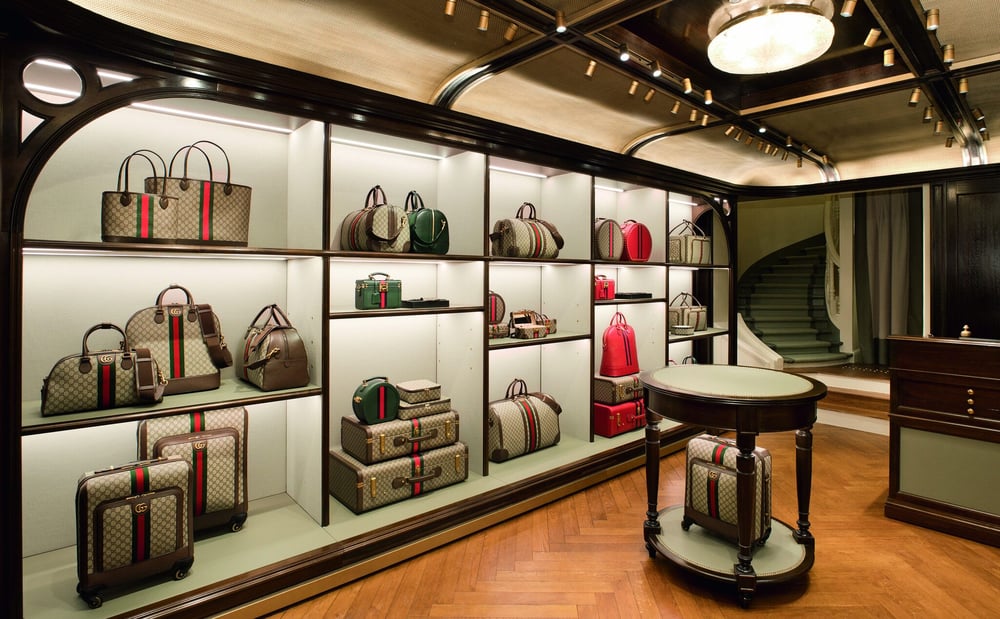
Florence, 1921. Imagine a city still healing from World War I, searching for its old grandeur. Into this moment steps Guccio Gucci with a simple, precise idea: make bags and luggage of real quality. Before he opened his shop, Guccio had worked at the Savoy Hotel in London. He watched the world’s wealthiest guests arrive with extraordinary luggage, and he understood something fundamental: people don’t just want an object. They want to feel that what they own is genuinely exceptional. So he opens a small shop on Via della Vigna Nuova and begins crafting handmade leather suitcases, bags, and saddles. The prices are high, very high for the time. But that’s exactly the point. Guccio wasn’t selling products. He was selling the right to belong to an elite that understands quality.
The years that follow are difficult. Italy’s economy is struggling. But Guccio has an eye for real materials, for solid construction, for elegant design. The wealthy people of Florence begin to notice the difference between an ordinary bag and a Gucci bag. The brand gains credibility among travelers who matter and among nobility. By the 1930s, he adds silk scarves and knitwear, but leather remains the true heart of the company. It’s what you do well, and you do it forever.
Who Guccio Really Was
Guccio wasn’t just a businessman. He was a craftsman who understood leather, materials, how things feel in your hands. Born in 1881, he was the son of a leather worker in Florence. Growing up in a workshop means learning from reality, not from books. You know when leather is good or when it’s cheap. You understand how it cuts, how it resists, how it ages. When Guccio works at the Savoy, he becomes fascinated by something important: the way wealthy people obsess over perfect objects. It’s not snobbery. It’s awareness. A Savoy suitcase is built to last a lifetime. This marks him. When he returns to Florence and creates Gucci, his vision is remarkably simple: never sell anything but what it’s truly worth. If something carries the Gucci name, it costs what a Gucci costs because inside it there is skill, real materials, thought toward the future.
During World War II, a difficult moment arrives. Leather becomes scarce. This is when you see the true craftsman. He doesn’t choose to make worse products. Instead, he invents the bamboo-handled bag. It’s a brilliant solution because it comes from the problem, it doesn’t hide the problem. It says: if I can’t use only leather, I’ll pair it with a different material that’s extraordinary. The result is a bag that becomes iconic not despite the war, but because of how Guccio faced the war. The philosophy is always obsessive and simple: quality above everything. Never compromise on quality. Never. When Guccio dies in 1953, he has transformed a small Florence shop into a name that anyone who understands real value recognizes.
Expansion and the Mistakes That Almost Killed It
In the 1950s, things change. Gucci opens in Milan, then New York. It’s not just geographic expansion. It’s recognition that the value of something doesn’t change when it crosses the ocean. In 1953, the Gucci loafer is born. The one with the horse-bit detail. You know it, right? It’s one of those luxury objects you see every day and don’t think is a masterpiece, but it is. Perfect in its simplicity, elegant without shouting. This loafer becomes constant in important shoe collections for a hundred years. In the 1960s comes the double-G monogram. It’s a signature, a way of saying: “Yes, it’s mine. Yes, it’s Gucci.” People who understand recognize the double-G like they recognize their own name.
In 1966, something romantic and intelligent happens. A Gucci designer named Vittorio Accornero creates a scarf for the film “The Taming of the Shrew” with Elizabeth Taylor. Not an advertisement. Simply the right scarf for the right moment. Princess Grace of Monaco sees it and asks for the same design in different colors. So a scarf from a film becomes a historic accessory, something elegant women still own today. It didn’t happen because of a marketing plan. It happened because it was beautiful and true.
Then come the 1970s and 1980s, and here Gucci meets its greatest enemy: itself. The sons of Guccio start fighting. Quality drops. Prices rise. Gucci remains a name, but loses its spirit. By the early 1990s, the brand is in real crisis. Then Tom Ford arrives. In 1994, Tom enters as Creative Director and does something extraordinary: he reminds Gucci who it is. He doesn’t rebuild everything from scratch. He strips away the flaws and pulls out what had been buried underneath. The 1995 collection is a shock. It’s Gucci, but contemporary. It’s luxury, but vivid. It’s what was missing: the courage to be elegant without fear.
What Makes It Last
Gucci has several products that define it completely. The loafer from 1953 remains what it always was: understated, perfect. The Flora scarf, created for a film, became something bigger than fashion history. The bamboo-handled bag shows that solving a problem can create something beautiful. The Dionysus bag, introduced in 2015, shows that you can honor heritage while being modern. The tiger-head closure doesn’t hide the past. It brings it forward.
Gucci dresses actors, musicians, aristocrats, and people with money who understand that spending well is an art. Audrey Hepburn wore it. Jackie Kennedy wore it. Contemporary celebrities wear it. But notice something: Gucci doesn’t chase trends. It sets them. Or better, it does what it does so well that when others follow, it seems like everyone is copying. That’s not accident. That’s craft meeting vision meeting time.
The Business Today
Gucci is one of the world’s largest luxury brands. In 2022, it reported revenue of 9.73 billion euros. Today, it operates more than 480 stores globally and employs about 17,000 people. It’s owned by Kering Group, a French luxury company, but the brand remains fiercely Italian in its DNA. The way it’s managed is carefully balanced between respecting what Guccio built and acknowledging that fashion changes.
The current Creative Director is Sabato De Sarno, who arrived in November 2022. He understands something important: you don’t erase what came before. You build on it. You ask: what was the intention of the bamboo bag? What was the intention of the loafer? Then you find ways those intentions speak to people today. Gucci competes with other major luxury brands, but notice: when Gucci succeeds, it’s not because it copied something. It’s because it remembered what it is.
Looking Forward
Right now, Gucci is serious about two things: sustainability and digital space. Making luxury that doesn’t harm the future isn’t a contradiction. It’s simply doing what Guccio did: refusing to compromise. If you can’t use leather that’s sourced responsibly, you wait. You find another way. You don’t sell something cheap and call it beautiful just because you’re rushed.
The brand is also exploring digital fashion and metaverse experiences. It sounds strange, but it makes sense: if fashion is about how people express themselves, then digital space matters. A Gucci bag in the metaverse still means something. It still represents choice and taste and value. The material changes. The intention doesn’t.
Why This Matters
Gucci has survived for more than a century because it understands something most businesses forget: your customers are smarter than you think. They know when you’re cutting corners. They know when you actually believe in what you’re making. Gucci hasn’t always gotten everything right. The 1980s proved that. But it came back because the foundation was real. Guccio built something that wasn’t just a business. It was an idea about how quality should live in the world. More than a hundred years later, that idea still works. That’s why Gucci matters.