Whispers of the Wild: Chimpanzee Trekking in Kibale
Kibale National Park
Kibale National Park in Uganda holds one of the largest chimpanzee populations in the country, tracked daily by rangers from the Uganda Wildlife Authority (UWA).
The discovery
Kibale National Park, often called the “Primate Capital of the World,” is home to over 1,500 chimpanzees, the highest concentration in Uganda, along with 12 other primate species. Tracking groups stay small, a maximum of six visitors per session. The Kanyanchu chimpanzee community has been habituated to human presence since 1993, and the sighting success rate runs over 90%.
Key experiences
Chimpanzee tracking
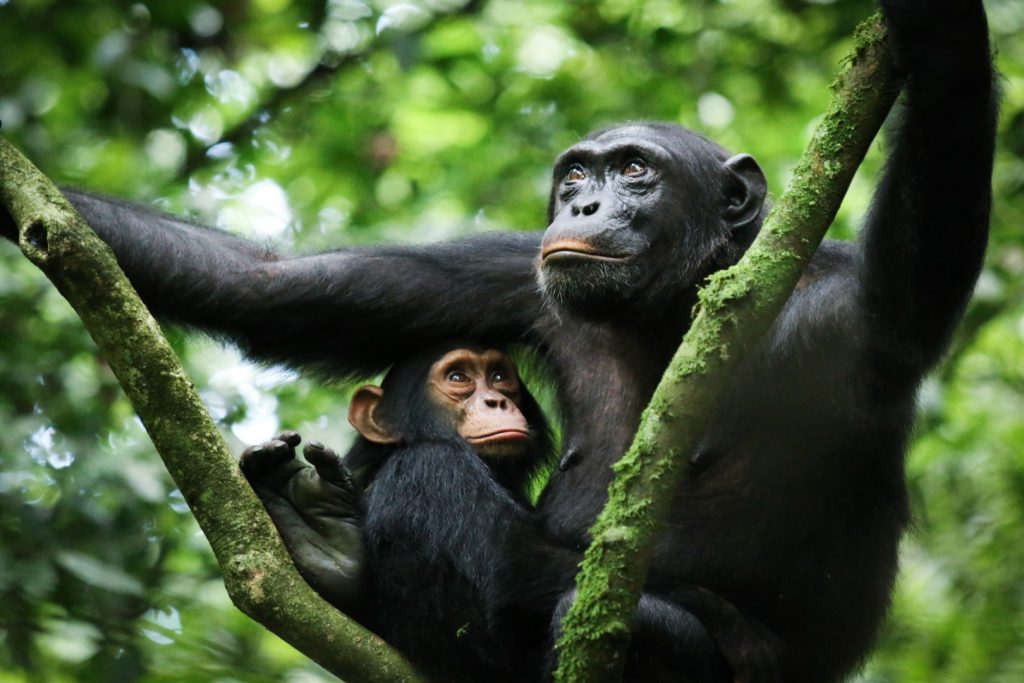
UWA ranger guides lead small groups to a family group in the middle of its morning routine: babies cling to their mothers, young ones chase each other, and the dominant male watches over the troop. The chimpanzee tracking permit costs $250 USD (approximately €230) per person for foreign non-residents, which includes one hour with the chimps once you find them. Trek sessions leave daily at 8:00 AM, 11:00 AM, and 2:00 PM from the Kanyanchu Visitor Centre, and the outing lasts 2-4 hours depending on where the chimpanzees are.
Chimpanzee Habituation Experience
The Chimpanzee Habituation Experience (CHEX) lets visitors spend an entire day with a semi-habituated community, following their full daily cycle from nest to nest. At $300 USD per person, it puts you alongside researchers in the forest as they collect data. You’ll see morning routines, feeding sessions, social interactions, grooming, and evening nest-building. Only four permits are issued daily, so book ahead.
Night walks and forest exploration
Kibale’s night walks cover the nocturnal side of the park. With torches and UWA guides, you’ll look for bushbabies, pottos, nightjars, tree hyrax, and the occasional civet or serval cat. Night walks are arranged through your lodge and usually cost $30-50 per person. During the day, the Bigodi Wetland Sanctuary, managed by the local community organization KAFRED, offers birding and primate watching just 6 kilometers from Kanyanchu.
Insider’s perspective
Go during the dry seasons: June to September and December to February. In those months the trails are more navigable and the chimpanzees are easier to find as they gather around reliable food sources. Primate Lodge is the only lodge inside the national park, a 5-minute walk from the chimpanzee tracking starting point. Its Sky Tree House, 10 meters above the ground overlooking an elephant meadow, has views of the forest canopy and occasional visits from colobus monkeys. Volcanoes Safaris’ new Kibale Lodge (opened 2024) has handcrafted bandas with views of the Rwenzori Mountains.
Practical wisdom
Book your chimpanzee tracking permit at least 2-6 months ahead, especially during peak seasons, since only 56 morning and 36 afternoon permits are issued daily. Work with a Uganda tour operator who can secure permits through the Uganda Wildlife Authority. Expect to spend $150-400 per night for accommodations near the park. Lodges like Kyaninga Lodge or Ndali Lodge run $400-700 per night. For the trek, wear lightweight, long-sleeved clothing in neutral colors (green, khaki, brown) and sturdy waterproof hiking boots. Skip bright colors and blue or black shirts, which attract insects. Bring garden gloves for gripping vegetation, a rain jacket, and insect repellent.
Where to stay
Primate Lodge Kibale has 9 luxury cottages, 7 standard cottages, and the Sky Tree House, with rates from approximately $200-350 per night including meals. The lodge is solar-powered. Kyaninga Lodge, on the rim of a volcanic crater lake, has views over the water. Crater Safari Lodge is 7 kilometers from the park. Chimpanzee Forest Guest House near the Kanyanchu Visitor Centre has self-contained rooms with views of tea plantations.
Closing note
Humans share about 98% of their DNA with chimpanzees. Permit fees go toward UWA conservation programs and the local communities around the park.